
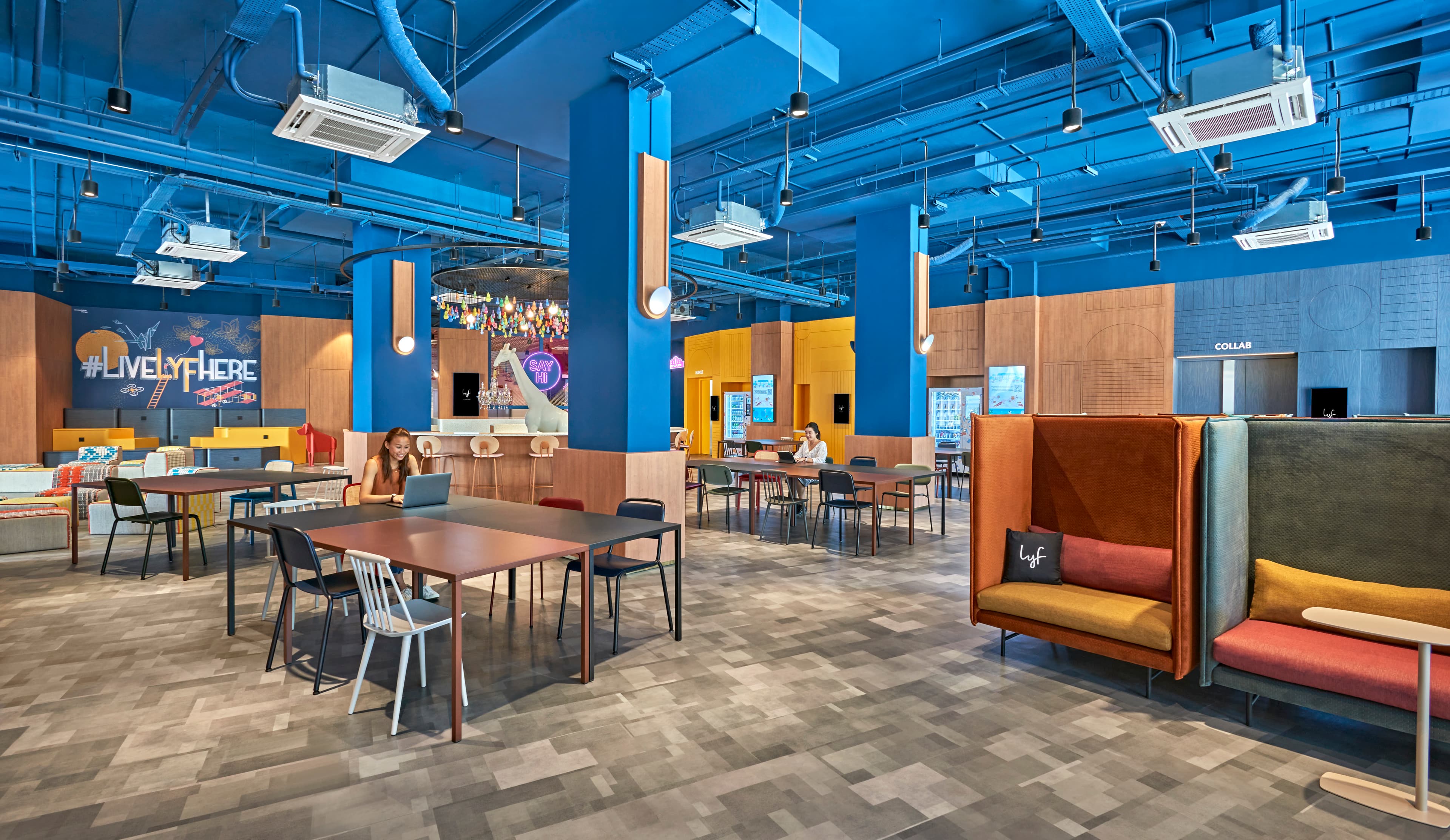
Named Asia's Finest Serviced Apartment at the 2026 Asia Hospitality Awards, lyf Farrer Park Singapore competes not on space or price but on place - commissioning local art and wiring guests into one of Singapore's oldest cultural grounds. The result reframes what a long stay is worth.
A studio at lyf Farrer Park measures fifteen square metres. In a city where an extended-stay guest can compare a hundred rooms on a phone before breakfast, fifteen square metres is not a selling point - it is a liability. Yet when the 2026 Asia Hospitality Awards named lyf Farrer Park Singapore the winner of 2026 Asia's Finest Serviced Apartment, the citation did not turn on the room at all. It turned on everything around it: the murals commissioned from neighborhood artists, the ground floor opened to the public, the tailors and henna artisans a two-minute walk away, and a district that has been a stage for a century.
That is the quiet argument this award makes, and it is worth taking seriously. For years the serviced-apartment category has been decided by two numbers - floor area and distance to a transit stop. lyf Farrer Park, operated by The Ascott Limited, the lodging arm of Singapore-listed CapitaLand Investment, won a category defined by those numbers by refusing to compete on them. Its differentiator is cultural rootedness: the building behaves less like an aparthotel and more like a patron of the place it sits in. The proposition it sells is not a room for a month. It is membership in a neighborhood.
A category with room to run - and a commoditisation problem
The timing is not incidental. Asia-Pacific's “living” sector - the umbrella that covers serviced apartments, coliving and multifamily rental - remains strikingly underbuilt as an investment class. According to CBRE's Asia Pacific Living Sector: Case for Investment (September 2024), the segment has accounted for just 6% of commercial real-estate investment volumes in Asia-Pacific since 2019, against 27% in Europe and 44% in the United States. CBRE names a growing expatriate population, low homeownership affordability and inflation-hedging capital as the forces that will close that gap, and singles out Singapore among the markets drawing fresh attention for serviced apartments.
A category with that much runway attracts supply, and supply invites sameness. The extended-stay guest of 2026 - CBRE's mobile expatriate, the relocating manager, the founder between leases - can already choose from a wall of near-identical aparthotels, each promising fast Wi-Fi, a kitchenette and a “local neighborhood”. When every operator claims locality, locality stops meaning anything. The interesting question the Farrer Park win raises is whether an operator can make locality structural rather than decorative - something built into the programming and the balance sheet, not sprayed on in a brochure. lyf Farrer Park is a test case for that question.
What “rooted” actually looks like
lyf Farrer Park opened in 2022 at 2 Perumal Road, on the edge of Little India and a two-minute walk from Farrer Park MRT. It offers 240 units across three formats - the compact “One of A Kind” and “Side by Side” studios at fifteen square metres, and larger two-bedroom “Two of A Kind” apartments, according to reporting by EdgeProp Singapore. On the specifications alone, it is a well-run small-format property. The specifications are not where the case lives.
Consider the art. The interiors are not merely “colorful”; EdgeProp reported that the property was decorated with murals by local artists drawing on the Farrer Park and Little India arts and cultural scene - commissioned work, sited in the building, made by people from the district it draws on. Consider the ground floor. Rather than a lobby sealed for guests, the launch configuration placed publicly accessible food and beverage on the street, including a pizzeria-brewery, alongside a co-working room and, on the fourth floor, an outdoor social deck with a shared kitchen and barbecue pits. The current in-house social spaces carry lyf's signature names - a BOND social kitchen, a BURN social gym - designed for residents to cook and train together rather than alone.
Then consider the neighborhood the building deliberately leaks into. The Ascott's own description points guests toward Little India's “colorful architecture” and its local artisans - custom tailoring, henna - as part of the stay, not a distraction from it. Skeptics might reasonably note that pointing guests at nearby shops is the oldest move in the hospitality playbook. Yet the record here is more deliberate than a concierge tip sheet: commissioned murals, public F&B, resident walking tours, and workshops add up to a property engineered to send its guests outward into the district and to bring the district's makers inward. The difference between decoration and patronage is whether the local artist gets paid and seen. On the available evidence, at Farrer Park they do.
The programming carries the same intent. Beyond the fixed design, the property runs resident workshops, curated events, and walking tours into the surrounding district, and keeps its social rooms - a co-working space, a social kitchen, an outdoor deck - configured for shared use rather than solitary convenience. What matters for the argument is not that such spaces exist; most coliving brands have versions of them. It is the direction they point. At Farrer Park they are aimed outward, at the neighborhood and its makers, rather than inward at a sealed community of guests. A workshop built around a Little India artisan is a different proposition from a residents-only mixer, and it is the former the property leans on.
A ground that has always been a stage
The choice of Farrer Park gives the strategy a spine most aparthotels can only envy, because the ground itself has a century of public memory. Long before it was a residential and medical quarter, the site was a racecourse: the Singapore Sporting Club ran its first meeting here in February 1843, per the National Library Board's heritage records. It became one of the country's first aviation stages - in March 1911 the Frenchman Joseph Christiaens flew and landed one of the earliest aircraft seen in Singapore on the racecourse, and in December 1919 Captain Ross Smith used the field during the pioneering England-to-Australia flight. Through the 1950s to the 1980s it was the nation's athletics hub, its cinder track opened in 1957 and its Sports House home to fourteen sporting associations. When Farrer Park MRT opened in 2003, its Art-in-Transit programme lined the station with work celebrating that sporting past.
This is not garnish. It is the argument. Farrer Park has always been a place where the public gathered to watch something happen - horses, then aviators, then athletes. A coliving house that commissions murals and throws its ground floor open to the street is not importing a "local flavor" theme; it is rejoining a lineage. That continuity is the sort of thing a competitor cannot buy or replicate on a greenfield site, and it is precisely what turns a serviced apartment into an address that means something.
The people behind it
lyf is Ascott's coliving brand, aimed squarely at what the company calls the “next-gen” traveller - in Farrer Park's case, guests roughly aged 25 to 45, weighted toward entrepreneurs and professionals relocating to Singapore. The brand's logic has been consistent as it has scaled across Asia. At the property's opening, Norman Cross, then Head of the lyf Brand and General Manager of lyf Singapore, framed the expansion around demand for “creative living and social spaces” where residents “live, work, and play with a community of like-minded people”, as quoted by Breaking Travel News. Ascott has not treated lyf as a novelty line but as a portfolio bet, opening property after property across the region on the wager that mobile, younger guests will pay for connection and character rather than square footage.
What distinguishes the Farrer Park expression of that bet is its specificity. A coliving brand can manufacture “community” anywhere with a shared kitchen and a WhatsApp group. It cannot manufacture a racecourse, an early airfield and a working artisan quarter next door. By anchoring the brand's social machinery to a genuinely storied district and paying local artists to put that district on its walls, the operator converts a generic value proposition into a defensible one.
Impact, on two levels
For the industry, the signal is pointed. If an awards body weighing Asia's serviced apartments hands its top prize to a fifteen-square-metre-studio property, it is telling the sector where the contest is moving: away from the amenity checklist and toward cultural rootedness as the thing guests actually pay a premium to feel. In a living sector with as much room to grow as CBRE describes, that is a strategic tell. The winners of the next cycle of extended-stay development in Asia may be decided less by how large the rooms are than by how deeply a property is woven into the block around it - a discipline closer to cultural curation than to real-estate development, and far harder to copy.
For the winner's own guests and neighbors, the value is concrete. A relocating professional living out of a fifteen-square-metre studio for three months gets something a serviced lease and a chain hotel both struggle to offer: a fast, low-friction entry into a real neighborhood, with the art, food and makers of that place built into the daily route. The mobility that CBRE identifies as the sector's growth engine has a hidden cost - placelessness, the sense of living nowhere in particular - and a property designed to push guests outward into Little India is, in effect, selling the antidote. The district's makers gain too: commissioned muralists, publicly accessible F&B and artisan referrals turn transient guests into local footfall. That reciprocity - a building that feeds the neighborhood that feeds it - is the most durable thing an operator can build, because it cannot be discounted away by the aparthotel opening next door.
There is an investor's version of the same point. In a living sector that CBRE expects to draw a wave of institutional capital, the properties most exposed to commoditisation are those whose only moats are location and fit-out - both of which a better-funded rival can eventually match. A property whose demand rests partly on commissioned local art, a public ground floor and a genuinely storied address holds a position that is harder to arbitrage. For an owner, in other words, cultural rootedness is not a soft virtue; it is a hedge against exactly the price competition a fast-growing, capital-flooded category tends to produce.
Two cautions belong in any honest account. The property's most striking early number - better than 90% occupancy within its first month, roughly two-thirds on long stays - comes from the operator's own launch reporting and should be read as a signal, not an audited fact; it has not been independently verified, and it is now three years old. And “cultural rootedness” resists measurement in a way that occupancy does not: no public dataset proves that the murals, not the location or the price, filled the rooms. The case rests on the design choices, the commissioned art, the open ground floor and the district - checkable facts - rather than on a claim that any one of them is decisive.
Closing
Fifteen square metres should have been a losing hand. That lyf Farrer Park played it into 2026 Asia's Finest Serviced Apartment is the whole point: the room was never the product. The product was the neighborhood, and the operator's willingness to pay into it. On a ground that has hosted horses, aviators, and athletes, a coliving house has made local artists the next act - and, in doing so, offered the extended-stay sector a more interesting question than 'how big is the room?' It is “how deeply does this place belong to its place?”
That question will be asked again next year on a larger stage. The 2027 Asia Hospitality Awards will convene in Bangkok, where the practices and properties shaping the region's next benchmarks - hotels and residences that treat locality as substance rather than decoration, as lyf Farrer Park has - will be recognized. Those whose work speaks that language can follow the conversation as it continues at ahawards.co.
PHOTO CREDIT: lyf Farrer Park